

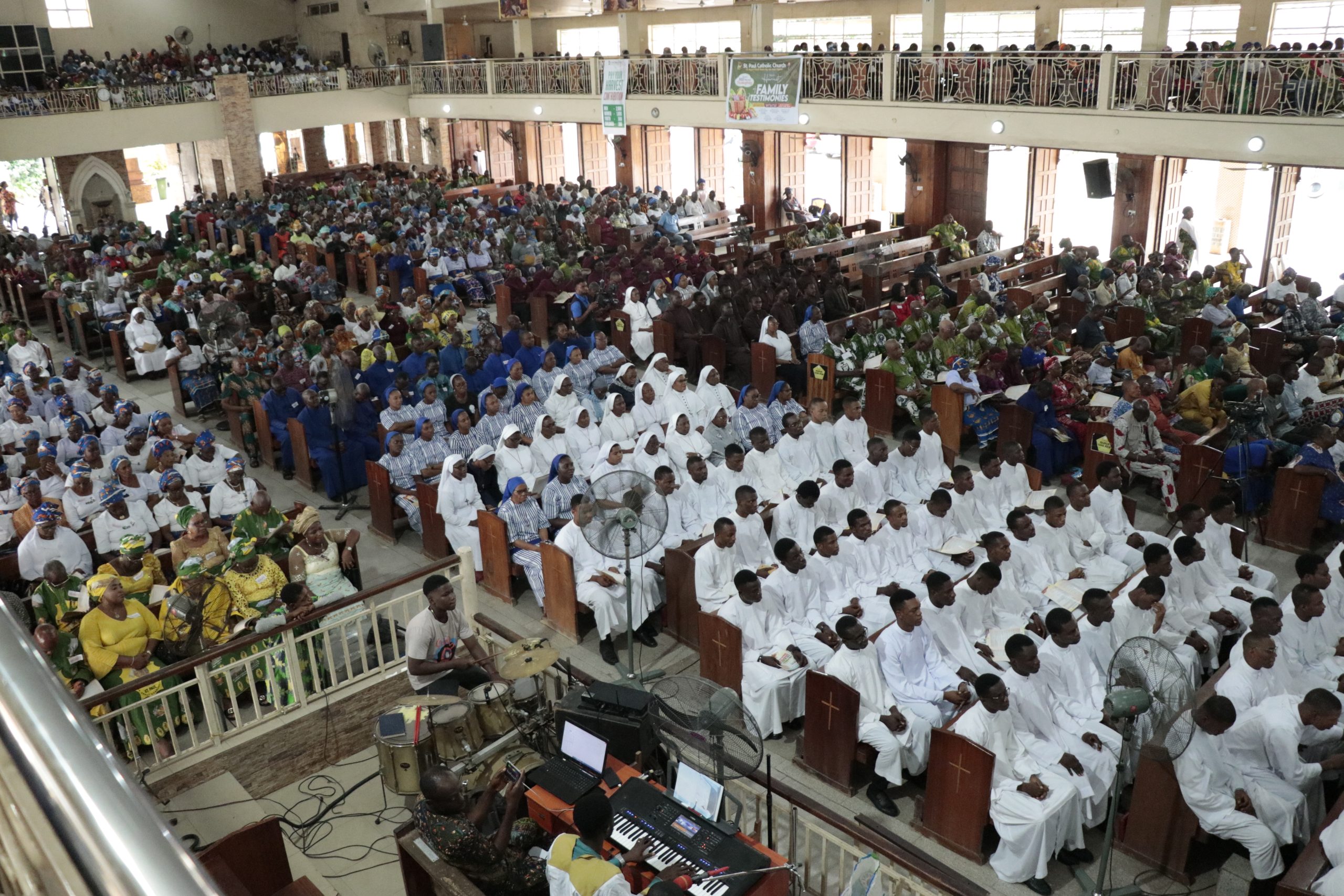
WHY THE CATHOLIC CHURCH RESORTS TO PRAYER IN TIMES OF NATIONAL TRAGEDY
– By: Rev. Fr. Dr. Okhueleigbe Osemhantie Ámos
In recent days, social media platforms have been awash with pastoral calls from various Catholic Provinces across Nigeria—Onitsha, Lagos, Benin City—urging the faithful to turn to prayer. More provinces will likely follow. Understandably, these calls have sparked questions, even frustration: *What kind of response is this? Why pray again?* When there were early signs of danger, bishops issued communiqués. Now that unspeakable inhumanity has unfolded in Benue State—again—they call for prayer. Is this all the Church can offer? Can she not face reality and act decisively? Must God be constantly invoked when His people are slaughtered?
Some critics go further: Isn’t this the same Christianity that teaches that “those who live by the sword die by the sword” (Matthew 26:52)? Didn’t Jesus say the Kingdom of God suffers violence, and the violent take it by force (Matthew 11:12)? Isn’t this the same Catholic Church that boasts of her knights, once defended Christendom at Lepanto, and has canonized soldier-saints? So why does she now shrink into what seems like a pacifist shell?
Such questions deserve honest reflection. Like many Nigerians, I too have felt the urge for decisive action in moments of national crisis. And yet, in every hour of unrest, genocide, massacre, or civil collapse, the Catholic Church invariably turns to prayer. This is not coincidence, nor is it weakness. It is a deeply theological response that arises from the Church’s unique identity and mission.
The Catholic Church is not first and foremost a political institution. She is a divine organism—born from the pierced side of Christ (John 19:34), animated by the Holy Spirit (Acts 2:1-4), and destined for the salvation of souls (1 Timothy 2:4). Her recourse to prayer in the face of terror is not retreat; it is realism at its highest. It is a proclamation that human crises are not merely political—they are spiritual. When bishops call for prayer, they are not dodging civil engagement; they are invoking heaven’s power upon earth’s pain. They are declaring that history, however bloodied, is not outside God’s reach.
In Catholic theology, prayer is not a substitute for action; it is action of the highest order. It is the opening of human anguish to divine grace, the insertion of eternity into the trembling timeline of nations. The Church sees the world through a sacramental lens: all that is visible is rooted in the invisible. Ethnic violence, political collapse, economic failure—these are signs of a deeper spiritual malaise. Prayer is the Church’s way of addressing the root, not just the symptom. It is the act of laying the nation’s wounds before the Divine Physician (Jeremiah 17:14).
Critics may mock prayer as inaction, a passive sedative for the desperate. But such cynicism betrays a worldview that has lost its sense of the sacred. The Catholic mind sees the cosmos not as a closed machine but as a creation that groans for redemption (Romans 8:22). The bishops who call for prayer do so not because they are blind, but because they see more than meets the eye. Even when Rome was collapsing before barbarian hordes, the Church did not call for a militia—she called for penance and prayer. Saint Augustine’s City of God was no battle plan—it was a reminder that the collapse of an empire is not the end of divine history.
Consider the primal tragedy of Scripture: Cain’s murder of Abel. God did not instruct vengeance. Rather, He said, “Your brother’s blood cries out to me from the ground” (Genesis 4:10). The Church, in this spirit, teaches that vengeance belongs to God—not man (Romans 12:19). This was not timidity. It is faith in action.
To those who ask, “What good is prayer in the face of horror?”, the Church responds: prayer is not magical thinking; it is moral protest raised to heaven. It is the cry of the innocent mingled with the plea of the faithful (Psalm 34:17). The soil of Agatu and Guma, soaked with blood, groans more profoundly when accompanied by a Church on its knees. Prayer is not a gesture of resignation—it is the Church refusing to answer violence with more violence.
Saint John Chrysostom once said, “The potency of prayer has subdued the strength of fire, bridled the rage of lions, silenced anarchy, extinguished wars, appeased the elements, expelled demons, burst the chains of death, expanded the gates of heaven, and assuaged diseases.” In similar vein, Saint Teresa of Ávila wrote, “Prayer is an act of love; words are not needed. Even if sickness distracts from thoughts, all that is needed is the will to love.”
To pray is not to ignore action — it is to ensure that any action taken is just and godly. Prayer restrains the heart from descending into vengeance. History proves that retaliation often creates more orphans and widows than justice ever can. The Church, therefore, insists that knees must bend before fists rise. Otherwise, what begins as resistance may devolve into vengeance, and justice may be lost to wrath.
Moreover, those who criticize the Church for “only praying” often overlook her silent yet powerful work behind the scenes. Bishops meet with political leaders and the state, plead with military commanders, negotiate for peace between warring parties, shield victims, and protect the voiceless. Priests and nuns run clinics, bury the dead, comfort the grieving, and house the displaced. These are not escape routes. They are weapons of light in a war of shadows (Romans 13:12). As Saint Padre Pio taught, “Prayer is the best weapon we have; it is the key to God’s heart.”
Yet deeper still is the Church’s conviction that God governs history without overruling human freedom. The Church does not teach fatalism. She preaches divine providence — a belief that God remains sovereign even when human hands are bloody. That is why, in moments of tragedy, the Church prays not to remind God of our pain, but to remind man of his need for grace. Unless the Lord builds the house, the builders labour in vain (Psalm 127:1). Only grace can disarm a gunman, convert a warlord, or illumine the conscience of a tyrant.
To accuse the Church of inaction is to ignore her profound and often quiet witness. She wears not the camouflage of retaliation but the white of peace, the violet of penance, the red of martyrdom, and the gold of eternal hope. She is the Bride of Christ who told Peter to put away the sword (John 18:11). She does not conquer by steel but by the Cross. In every massacre, when she chooses prayer over retaliation, she declares anew that death does not have the last word (1 Corinthians 15:54–57).
So let it be known: when the Church calls for prayer during national tragedy, she is not escaping reality—she is confronting it at its deepest level. She is not being soft—she is being faithful. The real tragedy is not only that people are killed, but that humanity is lost. Prayer reclaims that humanity. Prayer dignifies grief. Prayer restores moral order when all else fails.
To expect the Catholic Church to endorse retaliation is to ask her to betray her essence. She prays not because she has run out of ideas, but because she knows no idea can bear fruit without God’s blessing. Where others raise swords, she lifts the chalice. Where others burn with rage, she burns incense before the altar. She believes, with every fibre of her being, that nations are not saved by vengeance but by mercy — and mercy, once it reaches heaven, can shake empires.
_Rev. Fr. Dr. Okhueleigbe Osemhantie Ámos is a Catholic priest of the Diocese of Uromi and a Lecturer at the Catholic Institute of West Africa (CIWA), Port Harcourt, Nigeria_
