

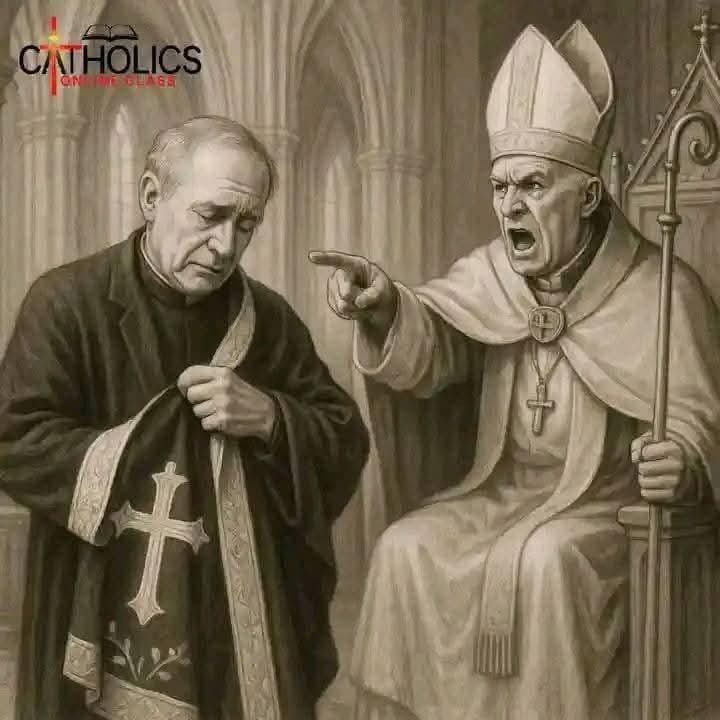
The Sacred Divide: Why the Catholic Church Calls Its Clergy Away from Politics and Toward Moral Leadership.
By Cajetan Didam Isah.
Historical Background:
Papal Power and Pastoral Mission. For over a millennium the popes exercised real political power in the Papal States, the temporal realm of the Church centered in central Italy. This ended in 1870 when Italian unification absorbed those territories. In 1929 the Lateran Treaty limited the Pope’s temporal rule to the tiny Vatican City State . Thereafter the Church consciously renounced direct governance of nations, embracing a new identity as a spiritual authority rather than a political one. As the Second Vatican Council taught, “Christ…gave His Church no proper mission in the political, economic or social order. The purpose which He set before her is a religious one” . In other words, the Church’s mission is “religious… but out of this religious mission… [the Church] can…consolidate the human community according to the divine law” . Vatican II therefore affirms that the Church should influence society by moral witness and charity, not by wielding direct political power or forming governments.
Canon Law and Magisterial Teaching on Clerical Neutrality. The official law of the Church codifies this separation. Canon 285 §3 of the Code of Canon Law plainly forbids priests from holding civil authority: “Clerics are forbidden to assume public offices which entail a participation in the exercise of civil power” . Likewise Canon 287 §2 instructs that priests “are not to have an active part in political parties” unless extraordinary reasons (defense of Church rights or common good) justify it .
The Catechism of the Catholic Church echoes this stance: “The Church…is not to be confused in any way with the political community. She is both the sign and the safeguard of the transcendent character of the human person” . At the same time, the Catechism affirms that the Church has a duty to pass moral judgments on political issues (“whenever the fundamental rights of man or the salvation of souls requires it”), but only by Gospel-based means . In short, priests may teach the moral principles that should guide politics, but they are not to become partisan politicians themselves. Church documents emphasize that lay Catholics (guided by conscientious formation) are the ones with primary responsibility to build just political structures, while clergy “give spiritual light and nourishment” . This division of roles preserves the unity of the faithful: a bishop or priest acting as a politician risks appearing as a partisan symbol rather than a shepherd for all.
Nigeria’s Political Landscape: Why Politics is Risky for Clergy.
Nigeria’s modern political scene is notoriously turbulent. Decades of military coups and contested elections have bred mistrust. Protests like End SARS have sometimes ended in bloodshed . The courts frequently see opposition challenges over violence, intimidation and fraud in elections . Everyday governance is burdened by corruption and uneven rule of law. Transparency International ranks Nigeria near the bottom globally (e.g. 150th in 2022) . Inflation, unemployment and poverty remain high , and armed groups (Boko Haram, bandits, herders’ militias) threaten stability  . In such an environment, any public office is fraught with pitfalls. Emeka Umeagbalasi, a Nigerian Catholic commentator, warns bluntly that “the political environment in Nigeria has not matured and is not spiritually or morally right for priests to be actively involved” . In practice, political parties and offices in Nigeria often entail patronage networks and “dirty” power struggles; even a well-meaning priest can be forced into compromises. As one analyst noted, the ruling APC (All Progressives Congress) is “a party of rogues,” making it unlikely any candidate – including a priest – can win without “playing dirty politics” .
The Church’s Message versus Political Partisanship:
In early 2024 the Nigerian Bishops’ Conference publicly reaffirmed that without authorization “no priest may engage in partisan politics or hold public office” . The bishops warned that unauthorized clerical politicking “scandalized a vast majority of Christ’s followers” . Such statements reflect the fear that the Church’s prophetic voice would be diluted if clergy become politicians. Indeed, local faithful are divided: some celebrated having a priest-governor (as “good leadership”), while others feared he would abandon spiritual duties or be ensnared in corruption  . In short, Nigeria’s systemic corruption and insecurity make political life dangerous for any leader – priest or lay – and potentially damaging to the Church’s witness if the politician falls short.
Fr. Hyacinth Alia: A Priest in Political Office
The most striking recent case is Rev. Fr. Hyacinth Iormen Alia, the parish priest elected Governor of Benue State in March 2023. A charismatic cleric known for his “healing Masses,” Alia ran as an APC candidate and won by a landslide. His campaign slogan – “Heal the Land. Heal Benue” – explicitly played on his priestly image and ministry  . (See illustration below.) Alia’s education (degrees in education and biomedical ethics) and reputation gave him popularity  . But his decision immediately ran afoul of Church law. Bishop William Avenya of the Gboko Diocese formally suspended Alia in May 2022 for defying Canon 287 §2: “Clerics are not to play an active role in political parties… unless… for the defense of the rights of the Church or to promote the common good”  . In his letter the bishop explicitly stated, “The Mother Church does not allow her clerics to get involved in partisan politics on their own” . Alia pressed on anyway; during the campaign he even wore his clerical collar (a move that “grated” on fellow priests) .
A political campaign poster from Benue State 2023 prominently features a priest-candidate (wearing a clerical collar) pledging to “Heal the land.” Such imagery underscores how clergy in politics draw on pastoral themes to appeal to voters.
Inaugurated on May 29, 2023, Governor Alia promptly addressed Benue’s acute crises: terrorism, banditry, and the Fulani-herder conflict that have displaced 2 million people  . Some observers applauded his compassionate approach, noting that he combined spiritual humility with promises of reform  . Yet critics questioned how a priest could operate within Nigeria’s cutthroat political environment without compromising his pastoral mission. Emeka Umeagbalasi bluntly noted that achieving office under the APC likely required “engaging in unethical political practices” . Others pointed out practical conflicts: as governor Alia joined meetings of the Progressive Governors’ Forum and lobbied for federal funding – duties far removed from parish life  . By June 2023, Alia stopped wearing his collar in public out of sensitivity to Church norms, though he said he intends to return to priestly ministry after his term .
Fr. Moses Adasu: Lessons from the Past
This was not the first time Benue put a priest in the governor’s chair. In 1992 Rev. Fr. Moses Orshio Adasu (now deceased) won Benue’s gubernatorial election (under the SDP party) while suspended from the priesthood. Adasu’s two-year term was relatively successful: he established Benue State University and kick-started the economy . He remained popular among local Catholics . However, his tenure also saw controversy and upheaval. Adasu clashed publicly with Godwin Daboh, a prominent businessman-turned-agricultural official. According to press reports, Daboh accused Governor Adasu of trying to dissolve a state agency board, which Adasu did, and then retaliated by publishing “serious allegations” of corruption against Adasu in the newspaper . These attacks tarnished Adasu’s reputation, and he ultimately left office in 1994 only when a military coup annulled civilian rule. Church leaders recall that Adasu’s political involvement generated both achievements and scandals. As commentator Mahmud Jega observed, the Church feared that “it [will happen] to Father Alia [what happened] to Father Adasu”: namely, that political enemies and even anti-graft agencies (like Nigeria’s EFCC) might later target the priest-governor  . Indeed, Jega warned that any governor – priest or not – risks later investigation for “money laundering and economic sabotage,” suggesting the Vatican’s caution in allowing clergy to run .
Consequences for Ministry, Collegiality, and Public Witness
The cases of Alia and Adasu highlight several consequences when priests enter politics. Suspensions and divisions. In both instances the diocesan bishop suspended the priest for disobedience to canon law  . This creates an obvious rift: the priest is both churchman and politician, and his brother clergy are forced to take sides. During his campaign, Fr. Alia’s wearing of the collar “grated against the sensibilities” of other priests who knew he was suspended . Such actions strain the collegiality among clergy; pastors who assume political office may no longer be seen as “our pastors” but as partisans. Scandal and confusion among the faithful. The Nigerian bishops noted that unauthorized clerical politics “scandalized a vast majority of Christ’s followers” . When a priest makes laws or enforces policies, it blurs the line between Church teaching and political ideology, confusing the laity. On the other hand, if a politician-priest is later disgraced by corruption allegations or authoritarian measures, it can deeply harm the Church’s credibility. Adasu’s fall-out with Daboh and the ensuing media smear cast a shadow on the Church’s image in Benue; a similar outcome could await any priest-politician.
The pastoral mission of the priest is also disrupted. Priests are called to sacramental ministry, preaching, and direct care for souls. Political office consumes enormous time and energy. As Vatican II taught, secular affairs “belong properly…to laymen,” who should drive society’s ordering; priests instead should provide “spiritual light and nourishment” . Alia himself assured some clergy he intends to return to parish ministry after his term , underscoring that political service is inherently time-limited and secondary to his vocation. Meanwhile, ordinary Catholics may feel orphaned in the interim if their beloved pastor departs the parish.
Finally, the Church’s collective witness is at stake. When a priest ventures into partisan politics, the Church institution risks being perceived as aligned with one faction. In Nigeria’s religiously and ethnically fractured society, that can inflame tensions. Church teaching warns priests are “symbols of unity” for all the faithful, and thus must avoid endorsing divisive parties  (as Pope John Paul II and Cardinal Onaiyekan likewise affirmed). Reflecting this, the Archbishop of Abuja (Cardinal Onaiyekan) has said flatly, “we don’t permit priests to dabble into politics” . By remaining above partisan contests, clergy protect the Church’s role as a unifying moral teacher to people of every party.
Why Priests as Moral Voices, Not Politicians
There are strong arguments theologically and practically for the Church’s stance. Theologically, priests represent Christ the Good Shepherd and the one, holy, catholic and apostolic Church. Their mission is to form consciences and speak prophetic truth, not to build power blocs. Canon law reflects this: priests may serve the “common good” not by running for office but by reminding politicians of moral duties (Canon 287’s exception exists only for defending the Church or greater good). The Second Vatican Council counsels that “[no one] is allowed…to appropriate the Church’s authority” for political ends . Instead, clergy teach virtue, highlight issues like justice or human rights, and leave the implementation of policies to qualified lay citizens.
Practically, priests in politics face temptations and compromises that are incompatible with their vows. Politics often requires negotiation, alliance-building, and sometimes concession of principles to gain consensus or votes. A priest’s credibility depends on an unblemished witness to Gospel truth. Accepting dirty money or making back-room deals is fundamentally at odds with the priestly calling to be poor, humble, and incorruptible. As the Nigerian bishops warned, violations of the Church’s laws in this area can even lead ultimately to canonical penalties (suspension or even dismissal from clerical state) . In short, the risk of scandal or moral compromise is high.
By contrast, when clergy refrain from partisan office, they are free to be outspoken moral voices on any public issue. The Church can thus criticize corruption, inequality, or injustice from the pulpit and pastoral letters, without being accused of pushing a political program. Catholics hear these moral teachings as coming from spiritual authority, not political self-interest. As the Catechism notes, it is part of the Church’s mission “to pass moral judgments…in matters related to politics…using means in accord with the Gospel and the welfare of all men” . Past Popes have repeatedly echoed this: priests and bishops must evangelize and serve as prophetic witnesses, not as politicians or military rulers.
Other Examples and Comparisons
This pattern is not unique to Nigeria. In many countries the Church discourages clerical politicking. For example, the Philippine bishops have long taught that priests and religious should be “symbols of unity” and must avoid overt partisan activity . A recent CBCP (Catholic Bishops Conference of the Philippines) catechetical note insisted that “the clergy can teach moral doctrines covering politics but cannot actively involve themselves in partisan politics” . In the United States, the late Father Robert Drinan served in Congress in the 1970s as a rare exception, but Pope John Paul II later asked him not to seek re-election, emphasizing the principle that priests usually serve the public good through ministry, not legislation. In Latin America, African countries, and elsewhere, Catholic priests have sometimes run for office with mixed results: while some brought dedicated service, others became embroiled in scandals or caused friction with bishops. Whenever a cleric assumes public office, the Vatican requires permission; unauthorized candidacies are virtually always met with suspension, as the Nigerian bishops have underscored .
Conversely, history shows that when the Church focuses on moral leadership rather than temporal power, it can unify diverse peoples. In Europe after World War II, for example, the Catholic Church in countries like Poland and the Netherlands exerted a powerful moral influence on politics (advocating human rights, social justice, etc.) without clergy themselves holding office. The Church’s social teaching and papal encyclicals guided policy indirectly through voters and parties. This prophetic role helped rebuild trust in the Church as an honest broker.
Conclusion: Priests as Prophetic Leaders
In a world hungry for integrity and truth, the Church believes its clergy are needed most not as politicians but as moral leaders. By stepping back from partisan contests, priests reserve their credibility to call all people – politicians and citizens alike – to higher ideals. Nigerian society’s struggles with corruption and violence show how treacherous politics can be for anyone, let alone a priest. Father Alia’s example in Benue – mixed blessings of hope and canonical concern – vividly illustrates the “sacred divide” between Church and state. The Church’s laws, council teachings, and the words of its bishops aim to preserve that divide so that clergy can focus on their true vocation: guiding consciences, uniting communities, and pointing souls toward God. In this way, they hope to offer a prophetic witness in politics without becoming politicians themselves.
