

Pope Francis and His Devotion to the Blessed Virgin Mary
Pope Francis’ pontificate is marked by a profound and consistent devotion to the Blessed Virgin Mary, a devotion that is neither sentimental nor abstract but deeply theological, pastoral, and rooted in ecclesial tradition. From his early life in Argentina to his papal magisterium, Francis consistently presented Mary as a model of discipleship, maternal intercessor, and a central figure in the life of the Church. This article explores the development of Pope Francis’ Marian devotion, its theological foundations, and its expressions in both his personal spirituality and public ministry.
Early Marian Devotion and Jesuit Influence
Jorge Mario Bergoglio’s Marian devotion began in his youth in Buenos Aires and was significantly shaped by his Jesuit formation. One of the most striking devotions he embraced during his studies in Germany was to Our Lady, Undoer of Knots. This Baroque image, which depicts the Blessed Virgin untangling the knots of a ribbon, symbolizes Mary’s maternal role in resolving the complex problems and spiritual struggles of human life. Pope Francis popularized this devotion in Argentina, where it became especially beloved among the faithful, and later introduced it to the broader Catholic world (Allen, 2015).
As Archbishop of Buenos Aires, Bergoglio frequently visited the shrine of Our Lady of Luján, the patroness of Argentina. He consistently promoted Marian devotions among the poor and emphasized their role in nurturing a culturally grounded yet theologically rich expression of faith (Allen, 2015). These experiences contributed to his vision of Mary as both an accessible mother and a guiding presence for the Church.
Marian Teachings in the Papal Magisterium
Pope Francis’ magisterium is filled with references to the Blessed Virgin Mary, not as an isolated theological figure but as someone deeply integrated into the mystery of Christ and the Church. His first apostolic exhortation, Evangelii Gaudium (2013), describes Mary as the “Mother of Evangelization.” He writes:
“With the Holy Spirit, Mary is always present in the midst of the people. She joined the disciples in praying for the coming of the Holy Spirit and thus made possible the missionary outburst which took place at Pentecost” (Evangelii Gaudium, §284; Francis, 2013).
Francis places Mary firmly within the ecclesiological framework of the Second Vatican Council, especially echoing Lumen Gentium’s eighth chapter, which presents her as intimately connected with the mystery of the Church. In Gaudete et Exsultate (2018), Francis refers to Mary as “the saint among the saints”, whose example teaches the way of holiness in ordinary life. Similarly, in Christus Vivit (2019), addressed to young people, he upholds Mary as a youthful disciple who acts with joy, courage, and faith.
Beyond his documents, Pope Francis’ liturgical decisions underscore his Marian theology. In 2018, he instituted the obligatory memorial of Mary, Mother of the Church, to be celebrated on the Monday following Pentecost. This decision emphasized Mary’s maternal presence in the life of the Church, a theme resonating deeply with the ecclesiology of the Council (Congregation for Divine Worship, 2018).
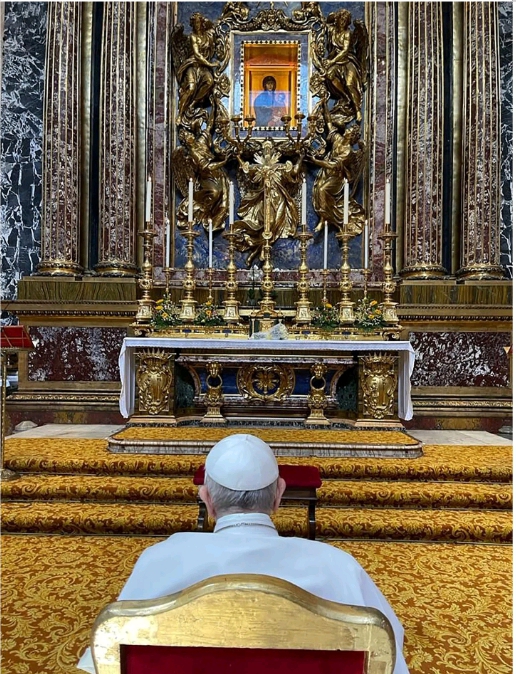
Pope Francis in prayer before the icon of Our Lady Salus Populi Romani, Papal Basilica of Saint Mary Major, Rome.
Liturgical and Pastoral Expressions of Devotion
One of the most visible expressions of Pope Francis’ Marian devotion is his consistent practice of visiting the Papal Basilica of Saint Mary Major before and after every apostolic journey. There, he prays before the icon of Salus Populi Romani – an image venerated by Romans for centuries due to its connection with their quest for divine protection. He often brings flowers and spends time in silent prayer, entrusting his missions to Mary’s care (Allen, 2015).
During times of global crisis, Francis called upon Catholics to seek Mary’s intercession. During the COVID-19 pandemic, he urged the faithful to pray the Rosary and even composed special prayers to be recited at home. On 25 March 2022, in response to the war in Ukraine, he led a solemn Act of Consecration to the Immaculate Heart of Mary, invoking her maternal care for the world and particularly for Russia and Ukraine (Francis, 2022, as cited in Vatican.va).
Key Marian Devotions Promoted by Pope Francis
Several Marian devotions are particularly associated with Pope Francis. Chief among them is his long-standing devotion to Our Lady, Undoer of Knots, which he has widely disseminated (Allen, 2015). He also places great importance on the veneration of Salus Populi Romani in Rome and encourages devotion to Our Lady of Luján, even sending her image back to Argentina in 2023 as a sign of spiritual closeness to his homeland (Allen, 2015).
Additionally, Pope Francis’ theological clarity is evident in his statements concerning Marian titles. While he deeply reveres Mary’s maternal role, he is cautious about overstating it. In a homily on the Feast of Our Lady of Guadalupe in 2019, he declared: “She never took anything away from her Son. He is the one Redeemer. She is a mother who points to him” (Francis, 2019, December 12). Such a perspective aligns with the Council’s teaching and helps maintain a Christocentric balance in Mariology (Burke, 2007).
Theological Foundations of His Marian Devotion
Pope Francis’ Marian devotion is shaped by several theological sources. His Ignatian spirituality encourages a Christ-centered approach in which Mary is always seen as leading believers to her Son (Burke, 2007). His pastoral theology also values popular piety, which he describes as a valid theological source (Evangelii Gaudium, §122 – 126; Francis, 2013). Francis believes that Marian devotion among the people, especially the poor, reflects a lived theology that is rich in insight and worthy of ecclesial attention.
Furthermore, his theological views reflect a post-conciliar Mariology that avoids extremes – neither exaggerating Mary’s role nor minimizing her unique place in salvation history. Instead, he presents her as the most faithful disciple, a maternal presence for the Church, and an example for all believers.
Conclusion
Pope Francis’ devotion to the Blessed Virgin Mary is a model of balanced, authentic, and spiritually rich Mariology. His personal practices, magisterial writings, and pastoral actions all reflect a deep reverence for Mary that is firmly rooted in the Gospel and the Church’s tradition. He upholds Mary not only as the Mother of God but also as a companion on the journey of faith – a mother who walks with her children, especially the poor, and intercedes for them with compassion and love. His Marian devotion, while deeply personal, serves the universal Church by reminding the faithful that Mary continues to play an essential role in the life of Christian discipleship and ecclesial mission. All these help us to understand why he desired to have his mortal remains interred in a Marian Sanctuary. The following is an excerpt from his Testament.
As I sense the approaching twilight of my earthly life, and with firm hope in eternal life, I wish to set out my final wishes solely regarding the place of my burial.
Throughout my life, and during my ministry as a priest and bishop, I have always entrusted myself to the Mother of Our Lord, the Blessed Virgin Mary. For this reason, I ask that my mortal remains rest – awaiting the day of the Resurrection – in the Papal Basilica of Saint Mary Major.
I wish my final earthly journey to end precisely in this ancient Marian sanctuary, where I would always stop to pray at the beginning and end of every Apostolic Journey, confidently entrusting my intentions to the Immaculate Mother, and giving thanks for her gentle and maternal care.
I ask that my tomb be prepared in the burial niche in the side aisle between the Pauline Chapel (Chapel of the Salus Populi Romani) and the Sforza Chapel of the Basilica, as shown in the attached plan.
The tomb should be in the ground; simple, without particular ornamentation, bearing only the inscription: Franciscus.
May God be gracious to his servant Franciscus. May the reward of his labours of love go with him into Paradise. May he find eternal rest in the company of Our Blessed Mother and all the saints. Amen.
References
Allen, J. L. (2015). The Francis Miracle: Inside the Transformation of the Pope and the Church. Time Books.
Burke, R. L. (2007). Mariology: A Guide for Priests, Deacons, Seminarians, and Consecrated Persons. Queenship Publishing.
Congregation for Divine Worship. (2018). Decree on the Celebration of the Blessed Virgin Mary, Mother of the Church. Retrieved from http://www.vatican.va/roman_curia/congregations/ccdds/documents/rc_con_ccdds_doc_20180303_bvm-mater-ecclesiae_en.html.
Francis. (2013). Evangelii Gaudium. Retrieved from https://www.vatican.va/content/francesco/en/apost_exhortations/documents/papa-francesco_esortazione-ap_20131124_evangelii-gaudium.html.
Francis. (2018). Gaudete et Exsultate. Retrieved from https://www.vatican.va/content/francesco/en/apost_exhortations/documents/papa-francesco_esortazione-ap_20180319_gaudete-et-exsultate.html.
Francis. (2019). Christus Vivit. Retrieved from https://www.vatican.va/content/francesco/en/apost_exhortations/documents/papa-francesco_esortazione-ap_20190325_christus-vivit.html.
Francis. (2019, December 12). Homily on the Feast of Our Lady of Guadalupe. Retrieved from https://www.vatican.va/content/francesco/en/homilies/2019/documents/papa-francesco_20191212_omelia-guadalupe.html.
Francis. (2025). “Pope Francis’ Testament,” Retrieved from https://www.vaticannews.va/en/pope/news/2025-04/pope-francis-spiritual-will-and-testament.html.
