

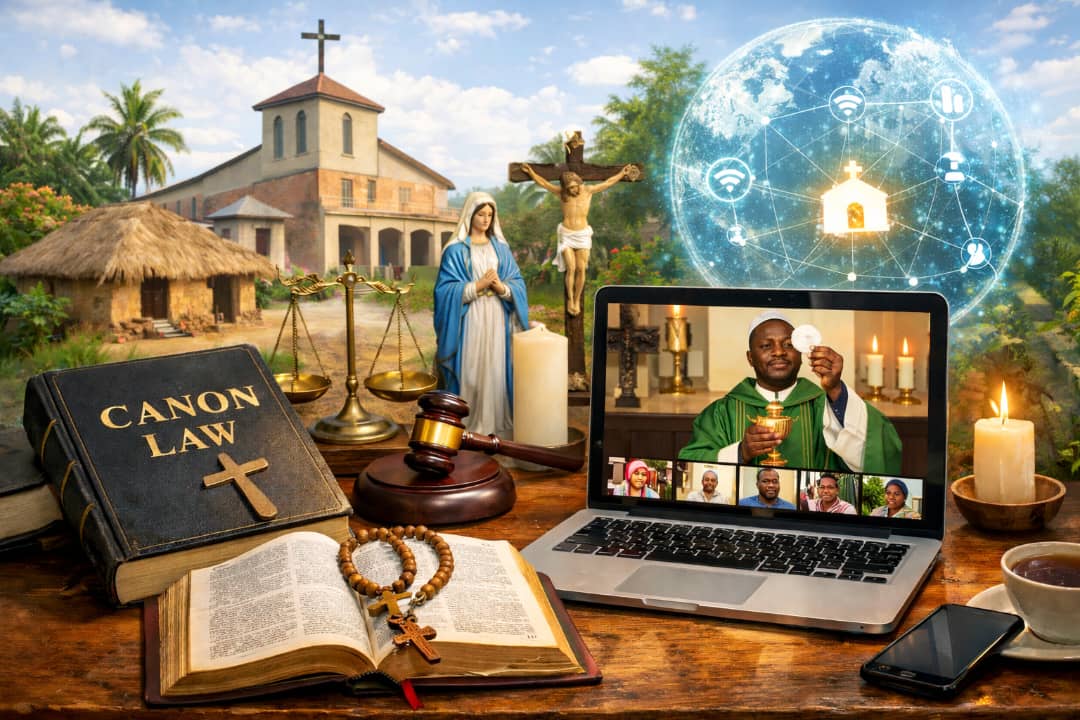
CHURCH LAW AND THE THEOLOGY OF ONLINE (VIRTUAL) MASSES
Fr. Dr. Okhueleigbe Osemhantie Ãmos|March 6, 2026
The Sacrifice of the Holy Mass stands at the heart of the Church’s life. The Fathers of the Second Vatican Council in Sacrosanctum Concilium describe the Eucharistic liturgy as “the summit toward which the entire activity of the Church is directed” and “the font from which all her power flows.” The Council’s teaching does not offer a mere devotional affirmation; it articulates a juridical and theological principle that has shaped subsequent canonical and pastoral norms. The Eucharist is not a symbolic recollection but the sacramental re-presentation of the one sacrifice of Christ on Calvary, offered in an unbloody manner under the appearances of bread and wine. For this reason, the Church has consistently exercised vigilant care over the conditions under which it is celebrated, participated in, and transmitted.
The 1983 Code of Canon Law establishes with clarity that the Eucharist is an action of Christ and of the Church, never a private act of devotion. Canon 837 §1 states that liturgical actions “are celebrations of the Church itself,” and Canon 899 §1 defines the Eucharistic celebration as an action of Christ and the People of God structured hierarchically. This juridical formulation presumes the concrete gathering of a liturgical assembly. The Mass is intrinsically ecclesial and communal, even when a priest celebrates _sine populo_; it is never an individual performance nor a spiritual broadcast detached from the visible Body of Christ.
The rapid expansion of digital media, intensified during the global crisis occasioned by the COVID-19 pandemic, led to a widespread recourse to livestreamed Eucharistic celebrations. While the Church, moved by pastoral solicitude, permitted and even encouraged such broadcasts during periods of grave necessity, she did not thereby redefine the nature of participation in the Mass. The Congregation for Divine Worship and the Discipline of the Sacraments, in its 2020 decree “In Time of COVID-19,” emphasised that extraordinary measures adopted during the emergency were provisional and motivated by public health concerns, not by a theological reconfiguration of Eucharistic participation. The faithful were encouraged to unite themselves spiritually to the sacrifice being offered, but the distinction between physical presence and mediated viewing remained intact.
This distinction is deeply rooted in Eucharistic theology. _Ecclesia de Eucharistia_ of Saint John Paul II streesses that the Eucharist builds the Church precisely through the sacramental encounter effected in the liturgical assembly. Similarly, _Redemptionis Sacramentum_ insists that the Eucharistic celebration must be carried out in strict fidelity to liturgical norms, precisely because it is not subject to private manipulation. The Church praises and recommends spiritual communion, a venerable practice encouraged by saints and theologians, yet she never equates it with sacramental communion. The reception of Holy Communion presupposes physical presence, proper disposition, and the ministerial act of distribution. No number of spiritual communions substitutes for the ontological reality of sacramental reception.
The Catechism of the Catholic Church teaches that the Eucharist is both sacrifice and sacred banquet, requiring a real gathering of the faithful. The Church’s law concerning Sunday obligation, articulated in Canon 1247 of the Code, obliges the faithful to participate in the Mass on Sundays and holy days of obligation. Participation, in its canonical meaning, entails physical assistance at a Eucharistic celebration celebrated in a Catholic rite. Viewing a Mass through television or digital platforms does not, of itself, fulfill the canonical obligation, except in circumstances where dispensation is legitimately granted by competent authority, as provided for in Canon 87 § 1 or provided for by law. The diocesan bishop, as moderator of the liturgy in his territory, may dispense from the obligation for grave cause, but such dispensation does not transform a virtual presence into sacramental participation; it merely excuses from the juridical duty under extraordinary conditions.
The question of place is equally regulated. Canon 932 §1 stipulates that the Eucharistic celebration is to be carried out in a sacred place, unless in a particular case necessity requires otherwise. Sacred places are designated precisely because the Eucharist is not a private event but the Church’s public worship. During the pandemic, temporary permissions were granted for celebration in alternative settings, yet these were governed by necessity and episcopal oversight. The routine celebration of Mass primarily for digital broadcast, especially when a priest has access to a concrete community capable of gathering, raises theological and canonical concerns. The Eucharist is ordered toward the building up of the local ecclesial community; it is not a parallel ministry existing independently of parish or diocesan structures.
The ecclesiology of communion articulated in _Lumen Gentium_ reinforces this point. The Church is a visible society structured by sacramental bonds. The Eucharist is the principal sign and cause of that communion. A virtual connection, while capable of fostering devotion, cannot substitute for the embodied reality of the ecclesial assembly. The Church has therefore been careful to distinguish between devotional access to a liturgical broadcast and actual liturgical participation. The former may nourish faith; the latter alone fulfills the juridical and sacramental structure willed by Christ.
Pastorally, the Church recognises situations of genuine impediment: the sick, the elderly, those caring for infants, and persons in regions without access to a priest may unite themselves spiritually to the liturgy through broadcasts. Canon 1248 §2 provides that if participation in the Eucharistic celebration becomes impossible because of the absence of a sacred minister or other grave cause, the faithful are encouraged to devote themselves to prayer for a suitable time. The canon does not redefine the Mass as virtual; rather, it acknowledges human limitation while maintaining the norm of embodied participation.
The role of the priest is likewise regulated. By virtue of ordination, the priest is configured to Christ the Head and acts in _persona Christi capitis_ in the Eucharistic celebration. Yet he does so within the communion of the Church and under the authority of his bishop. Canon 273 emphasizes the special obligation of clerics to show reverence and obedience to the Supreme Pontiff and their own Ordinary. A priest may not arbitrarily establish regular online Mass schedules that detract from or replace the pastoral care of a concrete community entrusted to him. The Eucharist is not a private apostolate to be shaped according to personal preference or digital reach. Even when celebrated without a congregation for a just cause, the Mass retains its inherently public character and must conform to liturgical law.
The post-pandemic period has therefore seen a careful recalibration. Bishops’ conferences and diocesan directives across the world have clarified that livestreamed Masses remain a legitimate pastoral tool, particularly for the infirm, but they do not create a new normative mode of Eucharistic participation. The theology of presence remains decisive. Sacramental reality is mediated through signs that require material proximity. The Church’s sacramental economy, as explained in Mediator Dei of Pius XII, resists reduction to mere visual or auditory experience. The liturgy engages the whole person: body and soul, within a gathered assembly.
Thus, while digital transmission may extend the reach of the Church’s voice, it cannot replace the incarnational structure of Catholic worship. The Eucharist is not simply watched; it is celebrated and received. The Church’s laws concerning place, minister, obligation, and participation are not administrative technicalities. They flow from a coherent theology of the Incarnation, ecclesial communion, and sacramental realism. The exceptional allowances granted in times of crisis were acts of pastoral charity, not precedents for permanent virtualization.
Thanks for Reading
Fr. Dr. Okhueleigbe Osemhantie Ãmos is a priest of the Catholic Diocese of Uromi and a Lecturer at CIWA, Port Harcourt, Nigeria
