

The Angelus
A Prayer that Stops Time for God
- At the sound of a bell, three times a day – morning, noon, and evening – Christians across the world pause in silence, bow their heads, and recite the words of a simple but profound prayer: The Angelus. This age-old devotion, centered on the mystery of the Incarnation, invites believers to step out of the rush of daily life and enter into a sacred rhythm – one that unites time, space, and soul with the eternal “Yes” of the Virgin Mary. For lay faithful in the modern world, The Angelus offers more than a moment of piety; it is a spiritual compass pointing us toward God’s presence in the ordinary.
The Angelus Prayer in Latin
The Angelus Prayer in English
℣. Angelus Domini nuntiavit Mariae.
℟. Et concepit de Spiritu Sancto.
Ave Maria…
℣. Ecce ancilla Domini.
℟. Fiat mihi secundum verbum tuum.
Ave Maria…
℣. Et Verbum caro factum est.
℟. Et habitavit in nobis.
Ave Maria…
℣. Ora pro nobis, sancta Dei Genetrix.
℟. Ut digni efficiamur promissionibus Christi.
Oremus.
Gratiam tuam, quaesumus, Domine, mentibus nostris infunde;
ut qui, Angelo nuntiante, Christi Filii tui Incarnationem cognovimus,
per Passionem eius et Crucem, ad Resurrectionis gloriam perducamur.
Per eundem Christum Dominum nostrum. Amen.
℣. The Angel of the Lord declared unto Mary.
℟. And she conceived of the Holy Spirit.
Hail Mary…
℣. Behold the handmaid of the Lord.
℟. Be it done unto me according to thy word.
Hail Mary…
℣. And the Word was made flesh.
℟. And dwelt among us.
Hail Mary…
℣. Pray for us, O Holy Mother of God.
℟. That we may be made worthy of the promises of Christ.
Let us pray.
Pour forth, we beseech thee, O Lord, thy grace into our hearts,
that we, to whom the Incarnation of Christ thy Son
was made known by the message of an angel,
may by his Passion and Cross be brought
to the glory of his Resurrection.
Through the same Christ our Lord. Amen.
Origins and Meaning of the Angelus
The name Angelus comes from the Latin opening words of the prayer: Angelus Domini nuntiavit Mariae – “The Angel of the Lord declared unto Mary”. Its roots are medieval, with origins traceable to the 11th and 12th centuries, particularly in monastic communities where monks would recite three Hail Marys at the ringing of the evening bell. By the 16th century, The Angelus had assumed its present form and was promoted by the popes as a devotional practice for all the faithful.
This prayer consists of three versicles and responses, each followed by a Hail Mary, and concludes with a short concluding prayer. It recalls the Angel Gabriel’s announcement to Mary, her humble acceptance, and the Word becoming flesh – a mystery at the very heart of the Christian faith.
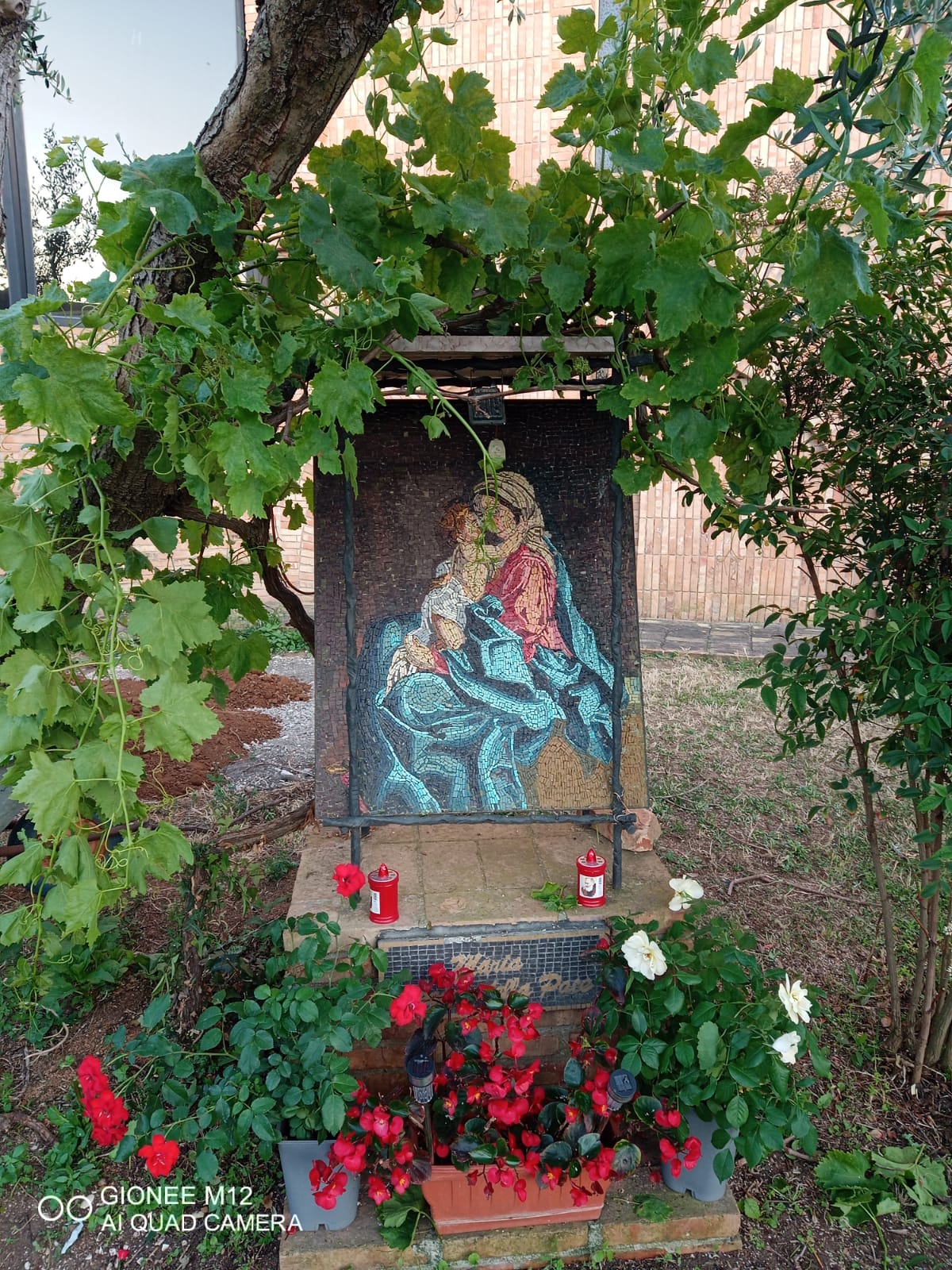
Mosaic of the Blessed Virgin Mary carrying the Incarnate Word of God, Jesus Christ. Beside and above it is a vine tree and its branches. Jesus is the true vine (cf. John 15:1)
Why the Angelus Matters Today
In a culture dominated by speed, distraction, and noise, The Angelus dares to suggest something countercultural: stop, listen, and remember God. It is a moment of recollection that allows daily life to be infused with eternity.
a. A Call to Pause
At 6 a.m., 12 noon, and 6 p.m., the ringing of the Angelus bell invites the faithful to interrupt their routines. These hours, once universally marked by church bells in villages and cities, offer sacred milestones in the flow of time – sanctifying the morning’s start, the midday busyness, and the evening’s rest.
b. A Devotion for All
Though born in monastic settings, the Angelus is a prayer tailor-made for lay life. Whether in the home, workplace, or street, it offers an accessible means of contemplation amid activity. It is short, memorized, and deeply rooted in Scripture (cf. Luke 1:26–38; John 1:14).
c. A Marian Encounter
Each recitation of The Angelus brings us into dialogue with the Blessed Virgin Mary – not as a distant figure, but as the model disciple. Her “fiat” (“Let it be done”) becomes the pattern of Christian response to God’s will. Through Mary, we are brought closer to Christ.
3. Structure and Theology of the Angelus
Let us briefly examine the structure of the prayer and its theological richness:
The Angel of the Lord declared unto Mary.
And she conceived of the Holy Spirit.
→ Theme: Divine initiative and human receptivity. God calls; Mary listens.
Behold the handmaid of the Lord.
Be it done unto me according to thy word.
→ Theme: Obedience of faith. Mary freely submits to God’s plan.
And the Word was made flesh.
And dwelt among us.
→ Theme: Incarnation. Heaven touches earth. Christ is Emmanuel – God with us.
The final prayer sums up the purpose: that through Christ’s Passion and Cross, we may be brought to the glory of the Resurrection. Thus, the Angelus is not just about Christmas only but it stretches toward Easter, reminding us that every “yes” to God leads to new life.
4. Living the Angelus Spiritually
For lay Christians, the Angelus can become a spiritual anchor in daily life. Here are ways to deepen your engagement with it:
Pray it alone or with family. Use a phone alarm or a physical bell as a daily reminder.
Reflect on its words. Don’t just recite – meditate. Let each phrase echo in your heart.
Unite it with your work. Offer your labor as Mary did her life: a gift for God’s glory.
Let it inspire silence. After praying, take a moment of stillness. God often speaks in silence (1 Kings 19:12).
Conclusion
The Angelus is a doorway to mystery – one that opens every day, three times a day, for anyone willing to enter. In recalling the Incarnation, it teaches us that God is not far off, but comes to dwell among us. In Mary’s “yes,” we learn the meaning of true discipleship. And in the gentle rhythm of its words, we find peace in a restless world.
If you have never made The Angelus a part of your life, begin today. In just three minutes, you can step into eternity – and invite the eternal into your present.
References
The Catechism of the Catholic Church. (1997). Vatican City: Libreria Editrice Vaticana. §§ 484–511; https://www.vatican.va/archive/ENG0015/_INDEX.HTM
Pope Paul VI. Marialis Cultus (1974). https://www.vatican.va/content/paul-vi/en/apost_exhortations/documents/hf_p-vi_exh_19740202_marialis-cultus.html
Enchiridion Indulgentiarum, 4th edition, Vatican, 1999.
Vatican.va – Latin Typical Editions of the Roman Missal and Devotional Prayers, http://www.vatican.va
United States Conference of Catholic Bishops, The Angelus, https://www.usccb.org/prayers/angelus
